

Why you should (and shouldn't) design your book proposal
+ the next NSSA skill building session

Before I dive into the post that was always meant to publish this week, I want to thank each and every one of you who have outreached since learning about my dad. To those who knew him and shared memories, and to those who didn’t but took the time to read about a man you never met, thank you. It means so much to me. He would often ask me about my newsletter readership and beam with pride to hear that people are subscribing to read words his daughter writes. He would be so grateful to each of you, knowing that he is being remembered, and also that I am being cared for by this community. ~Thank you~
Not So Secret Agent is an email newsletter all about the inside scoop on cookbook publishing from senior literary agent, Sally Ekus (that’s me!). Make sure we never miss the chance to connect. Subscribe to join this community.
Dear Not So Secret Agent readers,
I started my career in 2009, when the “blog-to-book” craze was just ramping up. Food bloggers with massive readership were landing high profile publishing deals left and right. Their online readers wanted a piece of their favorite tastemakers in book form.
I went from sending out proposals (back then we shipped them via snail mail!) printed in black and white and collated into folders personalized to each editor, to encouraging certain clients to “brand” their proposals to evoke an extension of their online vibe. Thus, mood boards for design teams or even fully designed proposals started to become more common.
The transition was tricky though. Frequently, publishers couldn’t see beyond what the author was suggesting. Many interpreted a mood board as an exact outline of what the author wanted/expected, not a starting place for creative collaboration. The rejections that came in contained feedback like, “My team didn’t resonate with the colors or the imagery,” or, “I worried that the author wouldn’t X, Y, or Z, in terms of the design.”
I often felt infuriated when an author, whose expertise was writing and recipe development, was judged by their mood board or light design suggestions. It didn’t help that this was also back in the day when authors and in-house design teams barely interacted. Thankfully, we have come a really long way since then! Now my authors get to hop on calls with their book designer; some even get to collaborate throughout the whole process.
As authors’ fluency in online platform grew, so did their ability to showcase and communicate what they wanted in the design of their book. During that evolution, mood boards became a welcome addition to proposals, and an “author’s vision” started to be incorporated the TOC (table of contents) of book proposals. Today, all proposals go out on submission electronically, and many of them are designed in and of themselves. At the very least, they have sample design “spreads,” which we will get into soon!

But Not So Secret Agent Sally, when should I design my proposal and when is that step unnecessary? Should I hire a professional designer? How much does it cost? Do I work on the content first? What happens if, after I sign with my agent, they want to change my book proposal, but it is already all designed?! How do I even go about finding a designer?!
I know, it’s like I am in your head, right? It’s a good thing I’ve answered these questions a time or two (or two hundred) over the years.
Well, my dear NSSA readers, these are nuanced questions that IMO have no rule-of-thumb answers. That said, I’ll share a few general guiding principles that may be helpful to you.
Before we get into the “shoulds” and “shouldn’ts” here, I’ll let you in on a few interesting facts.
Last year, I sold 12 book proposals (if you are looking for a deep dive into what goes into a non-fiction book proposal, see here). Four of those proposals were fully designed, meaning that the entire document, not just the sample material, was designed in some way or another. Two out of those four authors hired outside designers.
If you’re curious, this year’s numbers are shaking out similarly.
***Not So Secret Agent Side Note: In addition to my author led proposals, i have been selling more and more projects where the publisher is coming to me with an in-house generated idea and I am pitching a specific author to execute it. This should be a notable observation for those of you keeping a bird’s eye view on the state of cookbook publishing. ***
A fully designed proposal means the document itself, often in final PDF form, is evoking the entire look and feel for a project. The whole shebang, from the cover page to final sample word, is designed. Think of a fully designed proposal as a mini book.
A partially designed proposal means only the sample material is designed. These “sample spreads” illustrate how you want to lay out your content. This may be a recipe layout, or in other areas of non-fiction, perhaps a how-to section. Design helps reinforce, to show, rather than tell, while the partially designed proposal’s front matter is usually a standard word document. Think of this type of proposal as “proposal +.”
When should an author design their proposal?
You have a large platform online (or elsewhere) and an established brand identity. Maybe you have brand colors, fonts, or an aesthetic where people would know the content is yours even if your name was hidden.
Your book concept warrants an illustrative element. This might be a technique that is hard to explain in copy only. Or perhaps you want to write a single-subject book and design adds/enhances the explanation of the “why” behind the concept.
You have a strong opinion about what you want your book to look and feel like. Remember, you are proposing the book you want to write. IMO it is better to lay all your cards on the table from the get-go. That way your publisher has a visual aesthetic and orientation to begin your work together.
In select cases, I also suggest designing a proposal when the author has a small platform. Often the polish of a well-designed proposal can dial up the whole presentation of the content. It can also show a level of commitment the author is willing to invest – financially, sure, but also emotionally. Going through the design process is an added layer of work ethic. If it invites exuberance rather than exasperation, that can be a great sign!
***Not So Secret Agent Side Note: When people seeking representation pitch me a designed proposal, I always take a beat and try to strip the design away as I consider the content. I ask myself, if I removed all these bells and whistles, what is left? Do I like this idea? Is the material fresh and different? I don’t want to represent someone playing dress up; I want to represent the person making the clothes.***
You do NOT need to design your proposal if:
You don’t have strong feelings about what your book MUST look and feel like. Maybe you’d rather the expertise of your publishing team lead the conversation. This does not mean you won’t have quite a lot of input!
The time and resource investment in design overwhelms your ability to complete the content of the proposal.
You just don’t want to (and your agent agrees).
Should you hire a professional designer?
Honestly? Yes.
Sure, I mean, I bet you are great in Canva or InDesign. I bet you even watched a few YouTube videos on how to sew and now you’ve made a potholder that works as long as you don’t pull anything super-hot out of the oven 😉.
I always fall on the side of working with a pro.
What do most proposal designs cost?
In my experience, a fully designed proposal (soup to nuts, not just nuts in the spread), runs between $1,500-4k – most often landing around the $2k mark. This includes two rounds of edits after being presented with 1-2 general concepts. There are not a ton of back-and-forth rounds and the whole process could take anywhere from a few weeks to a few months, depending on the workload of everyone involved.
If you’re so inclined (and patient, optimistic, forgiving, etc.), you can try to hire someone from one of those sites where super talented people (and lots of not so talented people) deeply discount design services. In fact, I recently had a client wow me with a $250, 3-day turnaround job off one of those sites. Did my soul flicker a little? Yes. Does the proposal look amazing? Also, yes, though this is due in large part to the insanely fun nature of a culinary topic that was ripe for the designer to have a field day!
While I recognize that this entire newsletter is dedicated to book proposal design, please hear me when I say this: not everyone should consider designing their proposal. Not only is it not financially viable in many cases, but it is also often unnecessary. A standard word document converted to a PDF is more than sufficient most of the time. Today’s post is meant to help guide you down the design (or non-design) path best for you.
Other tips and info as you consider designing your book proposal:
Content comes first. Recipe test, copy edit, refine.
Do not invest in paying a professional designer before landing an agent. I want to represent clients who are open to the edits, feedback, and changes we will make to their proposal in our work together. I also want to work with clients who, even if their proposal is perfect, do not need to design it to go out on query. That said, if you send me a designed proposal, I often get excited! I just get budget conscious. Canva or InDesign may be totally sufficient before signing with an agent.
The Design of Books by Debbie Berne is a fabulous resource.
No need to overthink it. Chat with your agent. And if this newsletter post was the first time you even considered whether you should design your proposal, don’t bother!
So, where do you find these illustrious designers? Funny you should ask. I happen to be hosting my next NSSA Skill Building Session with one of my favorite freelance designers (proposals, books, consulting), Frances Abrantes Baca.
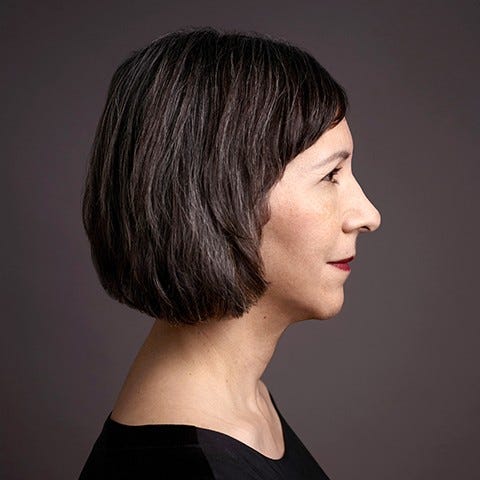
In addition to launching the @Headnotes Substack, which, you guessed it, is all about cookbook design, Frances is also…
a graphic designer, creative director, and creative consultant. She has designed and art directed many dozens of cookbooks in her 20+ year career, and has contributed writing on cookbook design as the former Design Editor at Stained Page News. Frances holds an MFA in Graphic Design from the Rhode Island School of Design, and her design work and writing have been recognized by the James Beard Foundation, the International Association of Culinary Professionals, the Society of Publication Designers, the Association of University Presses, and the New England Book Show.
During the skill building session, we will show you a few sample proposals. Frances will answer questions such as:
For book proposals:
Do you find the art, or is that given to you by the author?
Do you make suggestions for photography or illustration?
Are you involved in helping structure the text?
Re Cookbook Design:
Do you manage the photography and illustration? How, and at what stage does this happen?
Do you provide any art yourself?
How do you align your design with the publisher and author’s visions?
How do you manage feedback?
What are you keeping in mind as you’re designing a cover?
What makes for a successful cover?
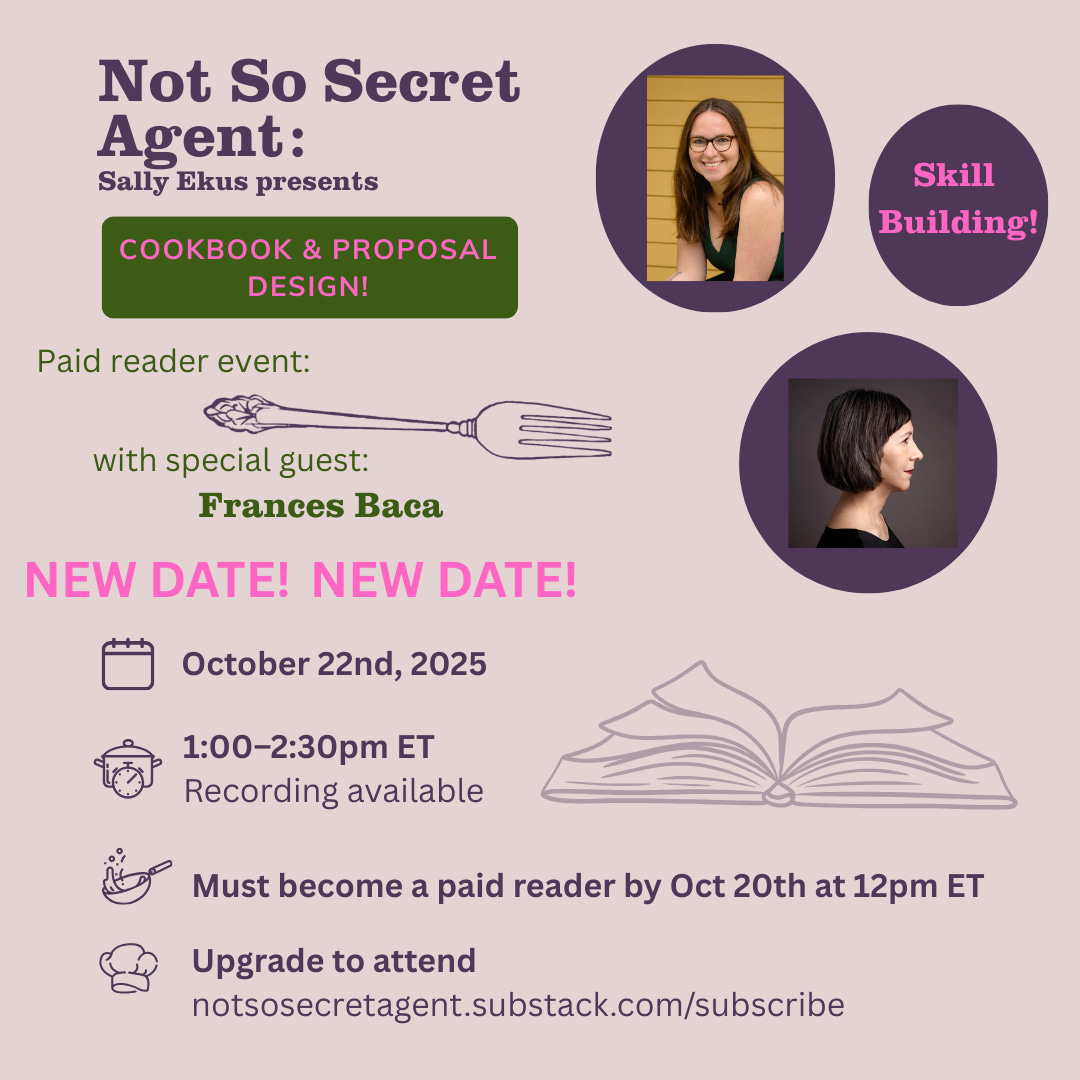
When: Wednesday October 22nd from 1-2:30ET.
Where: on Zoom (recording provided after)
Deets: The first hour will be an overview of book proposal and cookbook design/AUA (ask us anything!). Then, during the last 30 mins, I will facilitate an OFFER & ASK networking session.
This event is reserved exclusively for paying readers to ensure that those most engaged in professional development are in the same room. Equity spots are available as always.
Click HERE to upgrade your subscription. Reply to this email or send me a DM if you encounter any issues. The Zoom info will be provided on Monday October 20th.
One thing I know to be true about the Not So Secret Agent reader community is that you all really know how to show up for one another. Have you worked with a great proposal or book designer? Please comment below so everyone has access to an ongoing resource list.
From snail-mailed folders to fully designed PDFs, we’ve come a long way – and while there are no one-size-fits-all answers, writing a book is not meant to be easy, and that’s by design.
May there be magic in your day,
~Sally~
This was a great idea for a post. I usually don't advise the authors I work with on book proposals to have it professionally designed. Maybe it's because they have already spend money hiring me! LOL.
I was gratified to see that of the 12 book proposals you sold in the past year, only 2 were professionally designed. That tells me the extra expense is not necessary to sell a book.
Brilliant information, as always! Can’t wait for the session 😍