

INDEX FLEX
publishing's unsung heroes + INDEX skill building session


Not So Secret Agent is an email newsletter all about the inside scoop on cookbook publishing from senior literary agent, Sally Ekus (that’s me!). Make sure we never miss the chance to connect. Subscribe!

Before we dive into today’s regularly scheduled programming, I urge you to head over to The Salt Cure Restaurant Recovery Fund, which is offering relief to struggling restaurants. According to MPLS St Paul Magazine, “Restaurants can apply to Salt Cure for grants to cover payroll, rent or mortgage payments, and other urgent needs. The fund will prioritize small, independent restaurants that have been hardest hit; that may lack large platforms or networks to do their own fundraising; and/or that have been deeply committed to their community during this time. Applications will also be evaluated based on urgency, level of financial need, and community impact. The team behind the fund says they’ll also be working behind the scenes to identify “quiet crises”; those restaurants that may be in deep trouble but are afraid or unable to speak out publicly.”
If the past few weeks have shown us anything, it is that community is where strength, hope, and impact thrive.

Dear Not So Secret Agent readers,
Congrats on making it through January 486th.
I like to think I’m a pretty organized person, in both my personal (shoutout to the Big Basement Cleanout of 2025!) and professional lives (shoutout to my long-standing and mostly effective whiteboarding system).
In publishing, there’re a lot of people that help an author stay organized as their book makes the slow journey from bright idea to bookshelf standout. One of the few people I rarely get to cross paths with is that magical human who wraps up all the author’s hard work in an easy-to-navigate index after the book is done being copyedited.
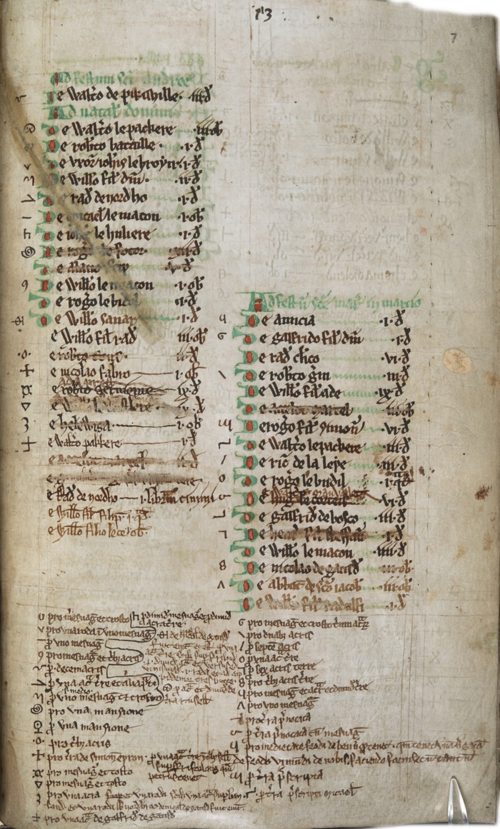
***Not So Secret Agent sidenote: <pushes glasses up in preparation for my inner nerd to come out> Yup, I went down another rabbit hole. Did you know that the word “index” derives from the Latin term to indicate or point out? That’s why your index finger is also called your pointer finger! If you’re like me and think this is important information to know, read this article about how every finger got its individual name.***

You may not think about it a lot, or even at all, but the index is a critical element in many nonfiction books. The cookbook is especially reliant on the index – it can make or break the user experience.
Pretend for a moment that you’re searching for a recipe idea for, say, ripe bananas. You crack open a promising baking cookbook and flip to the index, which advises you to head to page 67. Except that ripe bananas aren’t there. In fact, page 67 is a full-page hero shot of carrot cake.
Not good.
Wait, are there smashed bananas in the carrot cake?
Maybe. But the recipe isn’t on the opposite page either because page 67’s hero shot is the opener for the cake section.

As your book’s organizational hospitality, the index is an underdiscussed and largely unsung hero of your book baby.
Indexers are the people who create these critical things. In fact, compiling an accurate, user-friendly index is a bit of a superpower. Listen, not all heroes were capes. Some organize cakes. (hehe, see what I did there?!)
I still remember a dinner at the very start of my career where I got to meet one of these illustrious people. When Suzanne Fass introduced herself and started describing her work, I was floored by what was involved. In that moment, I realized that being a great literary agent meant getting to know each and every player along the way to making a book.
***Not So Secret Agent sidenote: Suzanne and I have stayed in touch for over a decade now, and she’s so great that she graciously offered to let me share her email with you. Reach her at fass@epsteinandfass.com. On top of that, she included a statement about what compelled her to get into this biz in the first place:
I got into editorial work because I hated the indexes in most of the cookbooks I owned—they were no help for finding the information I was looking for. What if I didn’t remember the exact name of a recipe, but just the main ingredient? What if I had extra of some ingredient that I wanted to use up in a different way? For the most part, no luck finding that. So I decided to learn to write the kind of index I wanted to use. And since 2003, that’s what I’ve done: copyedit, proof, and index cookbooks, and other nonfiction—several hundred books (to be honest, I’ve lost count!). My motto is: Making cookbooks safe for home cooks.
If you are inspired to reach out to Suzanne, please note that her subject expertise includes: culinary; lifestyle and self-help; business and public administration; children’s science. Her clients include traditional and independent publishers and authors, for book proposals, manuscript preparation, journals, trade books, and professional textbooks.
She has even been cited as a “notorious stickler” by the New York Times, January 4, 2004.
I would think that “stickler” is an important quality in an indexer.

Let’s take a moment to give indexers the love they deserve!
Today I have an introductory interview with Gina Guilinger, another recipe indexer, and I had the pleasure of meeting her recently at this past fall’s IACP Summit. It had been too many years between that first dinner with Suzanne and having the chance to dive deep with another indexer. When Gina told me what she does to help bring books across the finish line, I jumped at the chance to chat with her more.
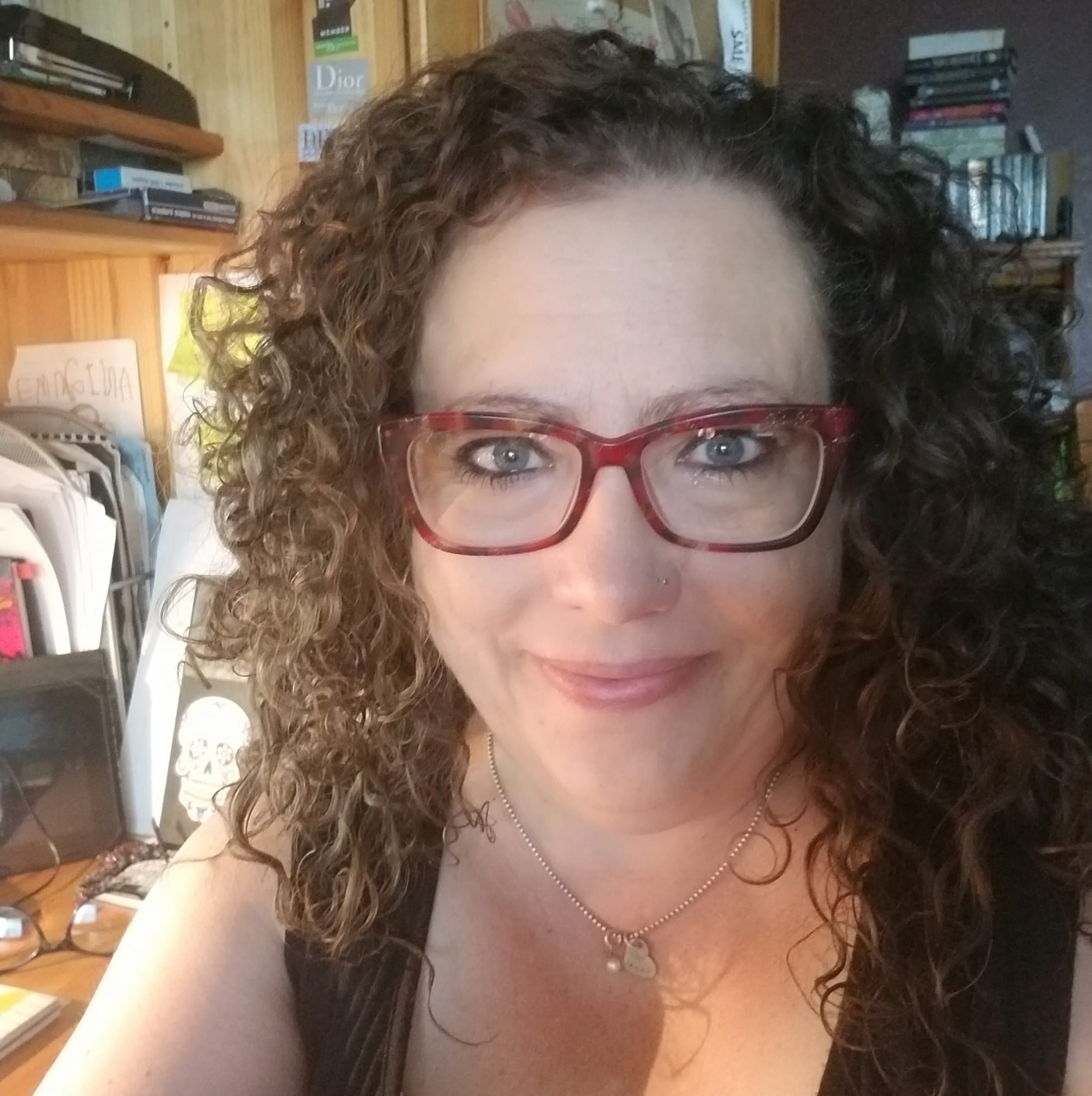
Gina Guilinger is the owner of Weight of the Word Indexing Service and has been indexing since 2011, specializing in back-of-the-book and database indexing. Her indexing interests and specialties include religion, culinary arts, earth sciences, social sciences, and criminology. Gina is a member and Past President of the American Society for Indexing.


Q: What is the key purpose of an index?
Gina: The key purpose of an index is to help readers locate information quickly and efficiently. The ideal index will contain all significant items and concepts from the text. It should provide multiple access points for readers who are unfamiliar with the author’s voice, as well as for those readers who are familiar with the text and would like to return to information previously encountered.
Q: Who usually hires you to index a book?
Gina: For my publisher clients, I am typically hired by a production editor. When I am working with self-publishing or hybrid-publishers, I am hired either directly by the author or by the project manager or book designer.
Q: What makes an index user-friendly?
Gina: User-friendly indexes will be organized in a recognizable structure, usually alphabetically. There should be cross-references directing users to related information and from synonymous terms to the author’s preferred terminology. Long strings of locators, or page numbers, should be broken down into subheadings. The user should be able to quickly find the information they are seeking.
Q: Is there anything an author can do to make your job easier?
Gina: The index is typically one of the last steps in the book process. The book’s pagination has to be set and all major editing completed before indexing can begin. For authors hiring an indexer directly, it is good to make contact once the schedule is set and maintain contact with any scheduling changes. Communication is welcome and most indexers are happy to work with any specific author requests. We will strive to find a balance between author requests, indexing best practices, and usability.

All this to say that most authors are happy (and lucky) to leave the indexing matrix to the experts. This is a good thing! The more people who can take tasks off our plate and help us stay organized, the better.
***Not So Secret Agent sidenote: Sometimes, authors are in charge of recommending or hiring their own indexers. Maybe you’re self-publishing and want to make sure to hire the real deal. In that case, both Susanne Fass fass@epsteinandfass.com and Gina Guilinger gina@weightoftheword.com have given me permission to share their emails with my readers. ***

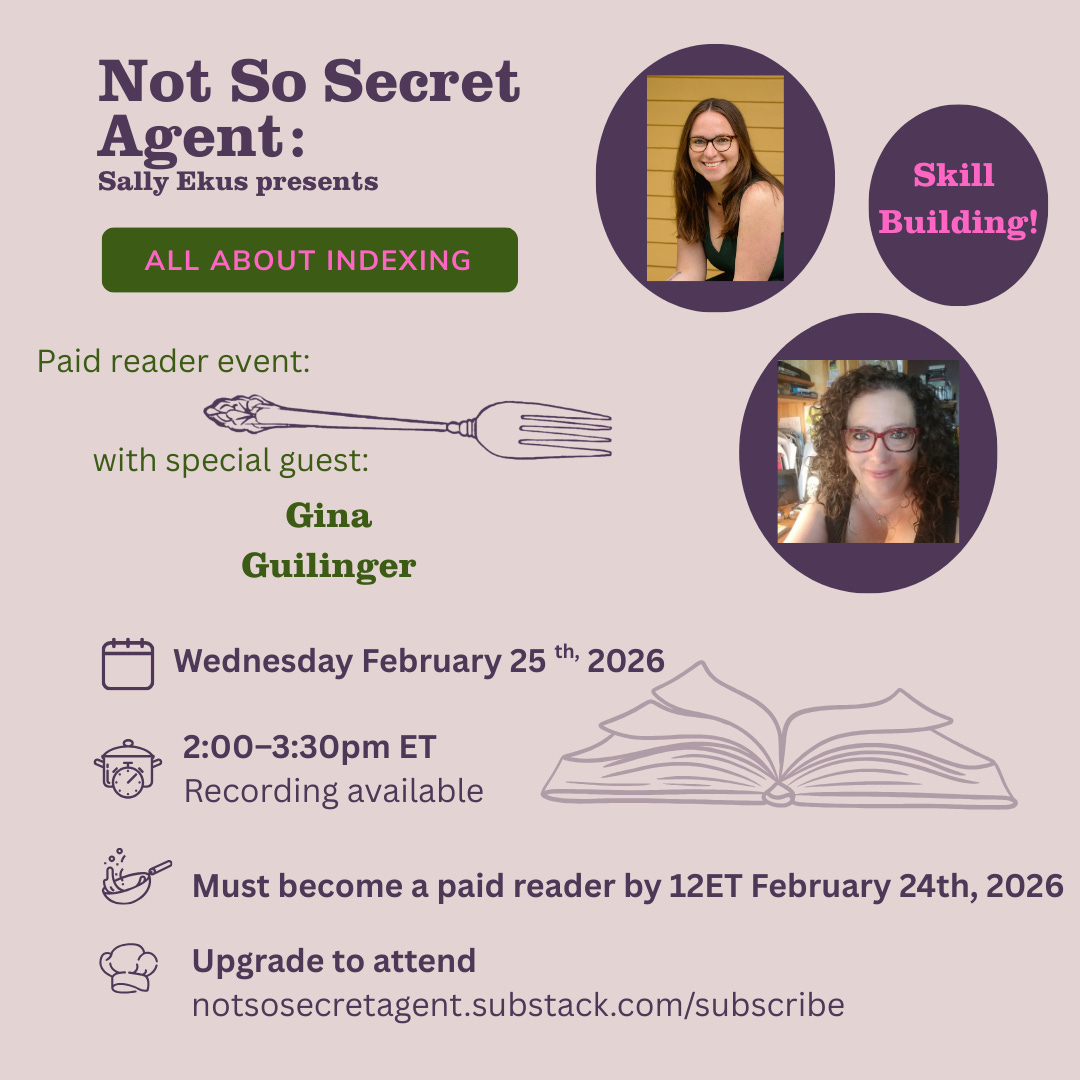
If today’s newsletter left you with more questions than answers and/or you want more insider chat about what an indexer does, I highly encourage you to come to the next NSSA Skill Building Session. Gina will be my guest! The topic? Indexing of course!!!
Gina and I will be diving into questions such as:
What is the author’s role in creating the index?
How long does it take to complete an index?
What is the most complicated index you’ve ever worked on and what issues came up?
And of course, how much does indexing cost and who pays?!
And so much more…
I want to emphasize that this skill building session is not just for you cookbook writers out there, though Gina does give a nod to cookbooks being her favorite type of book to index. This session will cover many genres and their various nuances.
These NSSA 90-min virtual chats are designed to offer you access to real humans working across the publishing industry such as recipe testers and book designers. The first 60 mins is a short presentation followed by Q&A from attendees. The final 30 mins is an OFFER & ASK session where I facilitate networking among the group. It is your chance to share about your work and connect with people to help support your current goals. Readers have formed proposal accountability groups, landed press placements, connected with recipe testing gigs, and so much more.
When: Wednesday February 25th from 2-3:30ET
Where: on Zoom (recording provided after)
This event is reserved exclusively for paying readers to ensure that those most engaged in professional development are in the same room. Equity spots are available as always.
Click HERE to upgrade your subscription.
This NSSA skill building session is for those of us who love and appreciate the craft of making a book.

Do you want to understand the full production process, even the parts you’re not involved in? Are you interested in demystifying what the heck is going on when your agent is negotiating a cap on the indexing fee in your next publishing contract? Are you wondering what the heck I just said? Great! Come join us!
~Sally~
There is a special gene that was given out to help the world relay information in a clear organized fashion. I always thought that editors were the chosen recipients, now I understand that the "indexers" were also given that blessing! Thank you for writing about this important art.
Thank you so much for that shout-out, Sally! I look forward to hearing what Gina has to say.
One point for authors who write their own indexes: Forget that you wrote the book, and approach the material as if you were a reader/user who never saw it before. What might you be looking for? Put all that in your index! And don't trust a computer publishing program to find it all and arrange it for you usefully, without a lot of extra work on your part (as Nava says).